Many buyers struggle to figure out which program fits their situation. Should you use military benefits you've earned, or does a conventional loan make more financial sense given your down payment savings?
The stakes are real. Your choice affects upfront cash needed, monthly mortgage insurance costs, how lenders calculate your debt-to-income ratio, and which properties you can buy. In a state where the FHFA's 2025 baseline conforming loan limit sits at $806,500 and climbs to $1,209,750 in high cost counties like Los Angeles and San Francisco, these differences add up fast.
This guide compares military eligibility, credit and income standards, down payment rules, the VA funding fee, private mortgage insurance, and California specific property considerations. We'll also walk through when each loan type makes sense for different buyer profiles.
Key Takeaways
- VA loans require military service eligibility; conventional loans don't
- Eligible VA borrowers may buy with no down payment and no monthly PMI, though a funding fee often applies
- Conventional loans offer down payments as low as 3%, with more flexibility for second homes and investment properties
- The right choice depends on your eligibility, cash reserves, credit, and how long you plan to keep the home
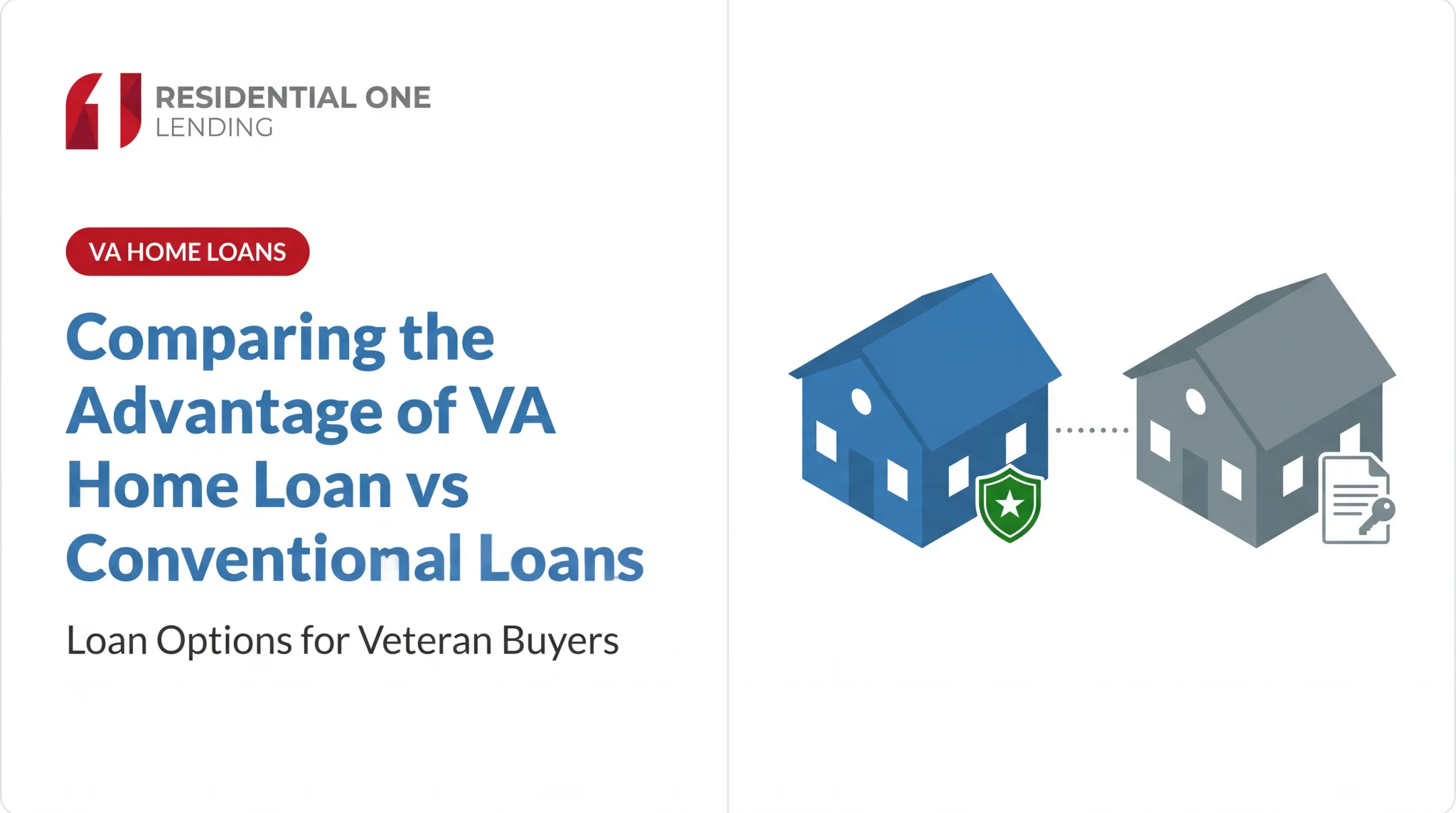
VA vs. Conventional Loans: Quick Comparison
Here's how the two programs stack up across the factors that matter most to California buyers.
| Factor | VA Loan | Conventional Loan |
|---|---|---|
| Down payment | As low as 0% | As low as 3% |
| Mortgage insurance | No monthly PMI; one time funding fee | PMI typically required under 20% down |
| Occupancy | Primary residence only | Primary, second home, or investment |
| 2025 loan limits | No VA cap with full entitlement | $806,500–$1,209,750 in California |
Down Payment
VA loans: Eligible borrowers may qualify for up to 100% financing when the sales price doesn't exceed the appraised value, according to the Department of Veterans Affairs. That said, closing costs, prepaid items, and earnest money can still require cash at the table.
Conventional loans: Down payment minimums vary by program. Fannie Mae's HomeReady and Freddie Mac's Home Possible both allow as little as 3% down for qualifying borrowers, though income limits and property restrictions may apply. Always verify current minimums with your lender rather than assuming one universal figure.
Mortgage Insurance and VA Funding Fee
VA loans skip monthly private mortgage insurance entirely. Instead, most borrowers pay a one time VA funding fee. Per VA Circular 26-23-6, first time use fees run:
- 2.15% with less than 5% down
- 1.50% with 5% or more down
- 1.25% with 10% or more down
Subsequent use pushes the lowest down payment tier up to 3.30%. Veterans receiving VA disability compensation, and certain surviving spouses, are typically exempt.
Conventional loans generally require PMI when the down payment is under 20%. You can often cancel PMI once you reach 80% loan-to-value, and it must terminate automatically at 78% LTV under the Homeowners Protection Act if payments are current.

Eligibility and Underwriting
VA underwriting leans on a Certificate of Eligibility, credit review, income documentation, and debt-to-income analysis. A 41% DTI ratio is a common benchmark, backed by residual income calculations for the West region, which includes California.
Conventional underwriting varies by lender and program:
- Manual underwriting often caps DTI at 36%, rising to 45% with strong credit and reserves
- Automated underwriting (like Fannie Mae's Desktop Underwriter) can allow DTI up to 50%
- Credit score minimums typically range from 620 to 680 depending on LTV
Property and Occupancy
VA loans require primary residence occupancy, VA appraisal, and adherence to Minimum Property Requirements covering safety, structural soundness, and sanitation. Condos must be in a VA approved project. Multi-unit purchases (up to 4 units) are allowed if you occupy one unit.
Conventional financing casts a wider net:
- Primary residences, second homes, and investment properties all qualify
- Second homes must be suitable for year round occupancy and can't function as rentals
- Investment properties follow separate underwriting rules with typically larger down payments
California Specific Costs and Loan Limits
For 2025, the FHFA set California's baseline conforming loan limit at $806,500, with high cost counties (Los Angeles, San Francisco, Orange, Santa Clara, and others) reaching the ceiling of $1,209,750.
VA loans work differently. Borrowers with full entitlement face no VA imposed loan limit, provided they qualify for the payment and the appraisal supports the price. Partial entitlement, common for borrowers who've used VA benefits before, ties the guaranty to county loan limits and may require a down payment.
Beyond the loan itself, California costs that affect your monthly payment include:
- Property taxes, generally capped near 1% of assessed value under Proposition 13
- Homeowners insurance, which varies significantly by wildfire risk and coastal location
- HOA dues, which nationally average $259 per month according to the National Association of Realtors and often run higher for condos
What Are California VA Home Loan Requirements?
A VA backed home loan is private lender financing with a VA guaranty on part of the loan. That guaranty is why lenders can offer competitive rates with little or no down payment. In California, the same federal VA rules apply: eligibility decides whether you can use the benefit, and a VA approved, state licensed lender still makes the final underwriting decision.
Who Qualifies for VA Benefits
Eligibility generally covers:
- Veterans with qualifying service and a discharge other than dishonorable
- Active duty service members with at least 90 continuous days of service
- National Guard and Reserve members who meet service duration requirements
- Certain surviving spouses of veterans who died in service or from a service connected disability
Borrowers don't need to be first time homebuyers, and the VA benefit can be reused across multiple home purchases.
Getting Your Certificate of Eligibility
The Certificate of Eligibility (COE) confirms your VA benefit status. You can request it online through VA.gov, ask your lender to pull it electronically, or mail VA Form 26-1880. Most lenders can start the process and pull the COE electronically for you.
Lender Qualification Factors
The VA doesn't guarantee loan approval; your lender still reviews:
- Credit history and score
- Stable, documentable income
- Debt-to-income ratio and residual income (what’s left after major monthly expenses)
- Employment history and asset verification
- Lender specific overlays (extra rules some lenders add above baseline VA guidelines)
Occupancy and Property Standards
California VA purchases must be primary residences. The VA appraisal checks for safety, structural soundness, and sanitation under Minimum Property Requirements. Condos need VA project approval, and 2-4 unit properties qualify if you'll live in one unit.

Document Checklist
Expect to gather:
- Government issued ID (driver's license or passport)
- Pay stubs from the last 30 days and W-2s from the past two years
- Bank and asset statements (checking, savings, retirement accounts)
- Tax returns if self-employed, including K-1s or corporate returns
- Military separation or service records (DD-214, etc.)
Exact documentation depends on your situation—use this as a starting checklist, not a final inventory.
What is a Conventional Loan?
A conventional loan is a mortgage not insured or guaranteed by a federal agency, according to the Consumer Financial Protection Bureau. "Conventional" isn't one single product. It's a category of programs with different underwriting rules, most following Fannie Mae or Freddie Mac guidelines.
Main qualification factors include:
- Credit profile and score
- Income stability and documentation
- Debt-to-income ratio
- Down payment size and asset reserves
- Property type and intended occupancy
Mortgage insurance, pricing, and reserve requirements shift based on these risk factors. A borrower with a 680 credit score and 10% down will see different terms than one with 740 credit and 20% down. Program guidelines change, so confirm current thresholds with your lender rather than assuming fixed rules.
Conventional financing tends to appeal to California borrowers who:
- Aren't VA eligible
- Want a second home or investment property
- Have already used their VA entitlement on another property
- Prefer a loan structure that fits their specific financial profile
Conventional programs generally offer more flexibility on occupancy. Primary residences, second homes, and investment properties can all qualify, each under its own underwriting standards. VA loans, by contrast, are limited to owner occupied primary residences.
VA vs. Conventional: Which Is Better for You?
Neither loan wins automatically. The right answer depends on eligibility, available cash, monthly payment tolerance, fees, property plans, credit, and how long you'll keep the loan.
Consider a VA loan when you:
- Meet VA service eligibility requirements
- Want to preserve cash for reserves or home improvements
- Plan to occupy the property as your primary residence
- Can satisfy VA appraisal and Minimum Property Requirements
Compare conventional financing closely when you:
- Have strong credit and meaningful down payment funds
- Want a second home or investment property
- Don't qualify for VA benefits
- Want to avoid the VA funding fee where it applies
Situations That Need Extra Analysis
Some scenarios don't have an obvious answer:
- Service connected disability: You may be exempt from the VA funding fee entirely, which shifts the math heavily toward VA financing
- Prior VA entitlement use: Partial entitlement may tie your guaranty to county loan limits and could require a down payment
- 2-4 unit purchases: Both programs allow multi-unit buying, but occupancy and income-counting rules differ
- Condo purchases: VA requires project approval; conventional condo approval follows separate Fannie Mae/Freddie Mac criteria
- High California home prices: In counties near the $1,209,750 conforming limit, jumbo financing considerations may enter the picture for conventional buyers

A Practical Decision Checklist
Before choosing, compare both options side by side:
- Upfront cash needed (down payment plus closing costs)
- Estimated monthly payment, including PITI
- Mortgage insurance or VA funding fee cost
- Interest rate and APR
- Total closing costs
- Required cash reserves
- Appraisal and property condition requirements
- Your refinancing or resale timeline
For example, an eligible California veteran with limited savings but strong income may lean toward VA financing to avoid a 10-20% down payment.
A veteran with substantial cash reserves who wants an investment property may do better with conventional financing, since VA loans are limited to owner occupied primary residences.
Working through these variables with a loan officer can save real money over the life of the loan.
Residential One Lending can review your VA eligibility, credit profile, cash position, and property goals and build a side-by-side VA vs. Conventional comparison. Residential One Lending is licensed in California under DBO Finance Lender's Law License #60DBO82448 and NMLS #1271616, and helps borrowers across the state weigh both paths before committing.
Conclusion
VA loans often deliver real value for eligible California borrowers: no down payment, no monthly PMI, and capped closing costs. Conventional loans earn their place too, particularly for buyers who need broader property flexibility, don't qualify for VA benefits, or fit conventional pricing well given their credit and cash position.
Eligibility rules, lender underwriting standards, and property condition requirements all matter. So do current California loan limits and your long term ownership plans.
Don't rely on advertised rates alone. Compare official Loan Estimates from VA and conventional programs side by side before you sign. Residential One Lending is licensed in California and can help eligible borrowers weigh both options and request those estimates.
Frequently Asked Questions
Can I get a VA loan in California?
Yes. Eligible veterans, active duty service members, qualifying National Guard or Reserve members, and certain surviving spouses can use VA financing in California. The home must be an eligible primary residence and meet VA and lender requirements.
What are the basic requirements for a VA loan?
You'll need qualifying military service, a Certificate of Eligibility, acceptable credit and income, manageable debt, and sufficient residual income. The property must also meet VA appraisal standards and serve as your primary residence.
Do VA loans require a down payment in California?
Eligible borrowers often qualify for no down payment financing when the sales price doesn't exceed the appraised value. Closing costs, prepaid items, and entitlement limits can still affect how much cash you need at closing.
Is a VA loan better than a conventional loan for a California homebuyer?
It depends on your eligibility, credit, cash reserves, property type, and long term plans. Compare personalized Loan Estimates from both loan types before deciding.
Do conventional loans require mortgage insurance?
Private mortgage insurance typically applies when your down payment is under 20% of the purchase price. Cancellation and removal rules depend on your loan terms and current loan-to-value ratio.
What is the VA funding fee, and can it be waived?
The VA funding fee is a one time charge that can be paid at closing or financed into the loan. Veterans receiving VA disability compensation, and certain surviving spouses, are typically exempt from this fee.