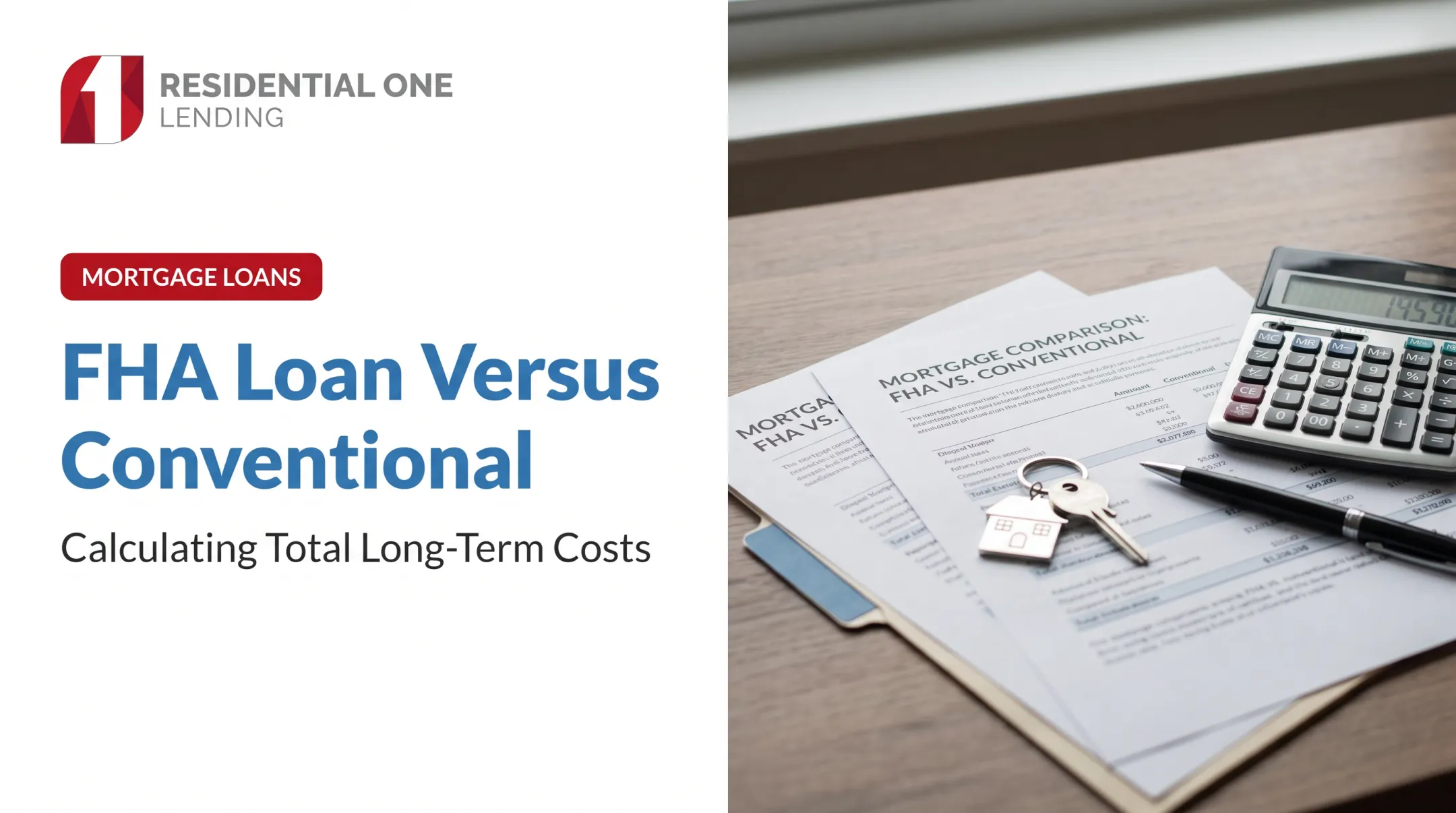
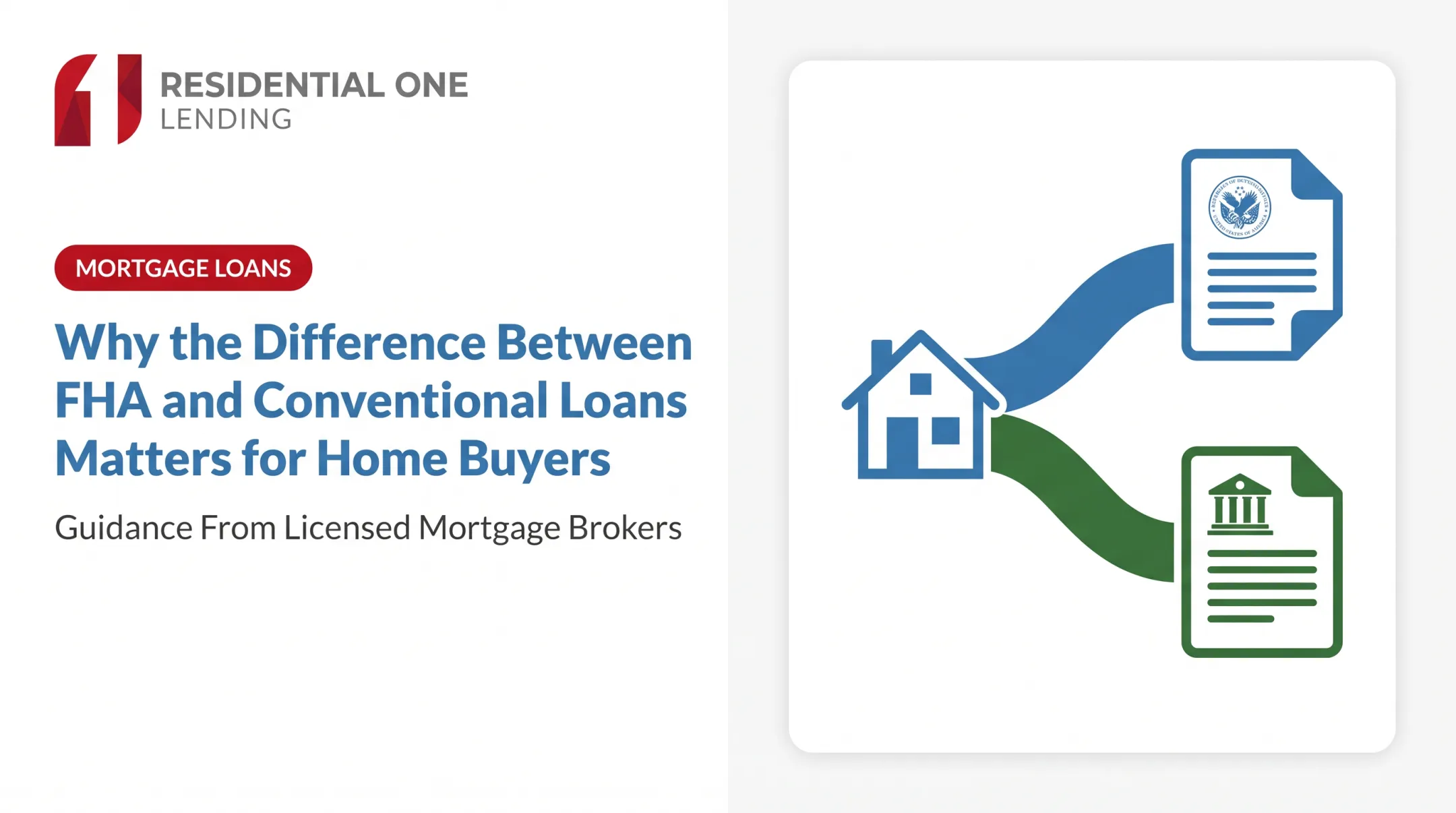
The right choice isn't about which loan has the lower advertised rate. It depends on your credit score, available cash, how much mortgage insurance will cost, the type of property you're buying, and how long you plan to stay put. A buyer with a 620 credit score and $10,000 saved faces a very different math problem than someone with a 760 score and 20% down.
This guide compares eligibility, down payments, mortgage insurance, property rules, loan limits, and total costs, then walks through practical scenarios showing when each loan tends to fit. Program rules change often, so confirm current figures with your lender before applying.
Key Takeaways
- FHA loans are government insured and easier to access with lower credit or smaller down payments.
- Conventional loans reward stronger credit and bigger down payments with better long term pricing.
- FHA mortgage insurance is upfront and ongoing; conventional PMI can cancel at 20% equity.
- Compare Loan Estimates for rate, insurance, closing costs, and how long you’ll keep the home.
FHA vs. Conventional Loans: Quick Comparison
| Factor | FHA | Conventional |
|---|---|---|
| Down payment | 3.5% (580+ score); 10% if 500–579 | As low as 3% on eligible programs |
| Credit floor | HUD 500; many lenders want 580+ | Typically 620 for manual UW |
| Mortgage insurance | Upfront 1.75% + annual; may last full term | PMI if under 20% down; cancelable |
| Occupancy | Owner occupied primary | Primary, second home, or investment |
Down Payment
FHA allows 3.5% down (96.5% LTV) with a score of 580 or higher. Scores from 500 to 579 need 10% down. Lenders may still set stricter overlays than the HUD minimum, according to HUD's Single Family Housing Policy Handbook.
Conventional financing has its own low down payment paths. Fannie Mae's 97% LTV options and Freddie Mac Home Possible both allow 3% down for eligible one unit primary residences. The exact amount still depends on the program, your credit profile, occupancy, property type, and the lender's own rules.
Credit and Debt-to-Income Requirements
FHA underwriting is generally more forgiving on credit. HUD's floor is 500, though many lenders want 580+. Manual underwriting caps housing/total DTI around 31%/43% for lower scores, and can stretch higher with reserves or residual income. Lenders still review:
- Payment history and recent delinquencies
- Income stability and employment gaps
- Available assets and reserves
- Any compensating factors that offset weaker areas
Conventional loans lean heavily on automated underwriting. DTI can run as high as 45–50% with strong compensating factors, but manual underwriting typically requires at least a 620 score for fixed rate loans. Pricing adjustments based on credit tier and LTV also affect your rate.
Mortgage Insurance
FHA charges an upfront mortgage insurance premium of 1.75% of the base loan amount, which you can roll into the loan. An annual premium (commonly about 0.50%–0.55% on a 30 year loan) is paid monthly. At high LTVs, that annual premium lasts for the entire loan term.
Conventional loans require private mortgage insurance only when you put down less than 20%. PMI can be canceled once the balance reaches 80% of the original value, with a clean payment history, and must automatically terminate at 78%.

Property Use and Condition
FHA financing is built for owner occupied homes. You must move in within 60 days and plan to stay at least a year. The appraisal also checks that the property is safe, sound, and secure, meaning major repair items often need fixing before closing.
Conventional loans allow more flexibility:
- Primary residences
- Second homes (must be suitable for year round use, not a rental)
- Investment properties
Appraisal standards tend to be less rigid on condition, though this varies by lender and loan program.
Best Fit at a Glance
FHA often fits when:
- Credit is limited or has past bumps
- Cash for closing is tight
- Gift funds will cover part of the down payment
Conventional often fits when:
- Credit and cash reserves are strong
- You want PMI you can cancel later
- You're buying a second home or investment property
What Are FHA and Conventional Loans?
What is an FHA Loan?
An FHA loan is a mortgage insured by the Federal Housing Administration and originated by an approved private lender. The FHA doesn't hand out the money directly. Instead, its insurance backstop makes lenders more willing to serve borrowers with lower credit scores, smaller down payments, or certain debt patterns.
Core eligibility factors include:
- Primary residence occupancy
- Documentable income and employment history
- Acceptable credit history and DTI
- Down payment tier matched to your credit score
- Loan amount within your county's FHA limit
- Passing an FHA appraisal
FHA loan limits for 2026 range from a national floor of $541,287 for a one unit home up to a ceiling of $1,249,125 in higher-cost counties. Alaska, Hawaii, Guam, and the U.S. Virgin Islands carry higher special-exception limits.
FHA also offers the 203(k) rehabilitation mortgage, which rolls purchase and repair costs into one loan. The Limited version covers up to $75,000 in minor, non-structural work; the Standard version handles larger rehabs starting at $5,000.
Use Cases of FHA Loans
FHA financing fits these situations especially well:
- First time buyers with steady income, limited savings, and a shorter credit history
- Borrowers who need a 3.5% down payment and more flexible credit guidelines than conventional loans allow
- Owner-occupants buying a 1–4 unit property, living in one unit and renting the others under HUD rules
What is a Conventional Loan?
A conventional mortgage isn't insured by a federal housing program. Most conventional loans are conforming, meaning they meet Fannie Mae or Freddie Mac guidelines and fall within the annual conforming loan limit. Loans above that limit are nonconforming, often called jumbo loans.
For 2026, FHFA set the baseline one unit conforming loan limit at $832,750 in most counties, with a high cost ceiling of $1,249,125. Conventional underwriting weighs credit score, loan-to-value ratio, DTI, cash reserves, property type, occupancy, and the specific automated underwriting system used.

Advantages that draw qualified borrowers include:
- Low-down payment programs starting at 3%
- Mortgage insurance that can be canceled as equity grows
- Broader use for primary homes, second homes, or investment properties
- Generally faster underwriting since terms have industry-wide acceptance
Those benefits come with tradeoffs: stricter qualification for weaker credit profiles, loan level pricing adjustments, and reserve requirements that climb quickly on non-primary properties.
Use Cases of Conventional Loans
Conventional financing makes sense when:
- Credit is strong, finances are stable, and the down payment is large enough to avoid or minimize PMI
- You plan to stay long enough for PMI cancellation and stronger long term pricing to matter
- You're buying a second home (typically 10% down) or one unit investment property (typically 15% down), with several months of reserves
FHA vs. Conventional Loans: What Is Better?
Neither loan wins outright. The better option is whichever produces the right combination of approval odds, cash needed at closing, monthly payment, total cost, and flexibility for your specific situation.
| Factor | Tends to Favor FHA | Tends to Favor Conventional |
|---|---|---|
| Credit score | Below roughly 680 | 680 and above |
| Cash saved | Under 10% of price | 10%+ of price |
| Mortgage insurance preference | Accepts fixed, long term MIP | Wants insurance that cancels |
| Property plans | Primary home, minor repairs needed | Second home or investment property |
| Time in home | Uncertain or shorter | Long term hold |
A few things to weigh directly:
- Credit and down payment: Weaker credit or limited funds often make FHA more accessible. Stronger credit and more cash usually unlock better conventional pricing.
- Full monthly and long term cost: Compare principal, interest, MIP or PMI, taxes, insurance, and closing costs over your hold period. FHA's upfront premium and ongoing MIP can cost more than conventional PMI that cancels in a few years.
- Property and occupancy: FHA generally rules out second homes and pure investment properties. Its property condition standards can also complicate offers on older or distressed homes.
- Other variables: Loan limits, purchase price, reserves, gift funds, seller concessions, and lender overlays can all shift the answer.
Compare official Loan Estimates side by side for both scenarios. Residential One Lending's mortgage brokerage team can walk through available FHA and conventional pathways for your specific numbers.
Real World Scenarios and Comparison Examples
Figures below are illustrative estimates, not quoted rates.
Scenario 1: First time buyer, moderate credit, limited savings. A borrower with a 620 credit score buying a $300,000 home has roughly $10,000 saved.
- FHA: 3.5% down ($10,500) plus a financed 1.75% upfront MIP (about $5,076 added to the loan). Annual MIP near 0.55% adds roughly $130–$150 per month.
- Conventional 97% LTV: 3% down ($9,000), but credit-based PMI at this tier can price higher than FHA’s flat MIP.
- Takeaway: FHA’s more flexible DTI rules often make approval easier here when savings and credit are tight.
Scenario 2: Stronger credit, bigger down payment, long term hold. A borrower with a 740 score puts 15% down and plans to stay 10+ years.
- Conventional: PMI cancels automatically around 78% LTV—often within a few years with steady payments and normal appreciation.
- FHA: At 85% LTV, annual MIP lasts 11 years (not the full term), but it still won’t drop off early the way PMI can.
- Takeaway: Over a decade plus hold, conventional usually costs less overall for well qualified borrowers.
Scenario 3: Fixer upper, second home, or investment property. Occupancy and condition rules often decide the path before rate shopping does.
- Fixer upper: Structural work may require an FHA 203(k) or a conventional renovation loan (such as Fannie Mae HomeStyle); standard FHA appraisals flag major deficiencies before closing.
- Second home or investment: FHA’s owner occupancy rule generally blocks these uses, so borrowers shift to conventional financing—usually with a larger down payment.
Practical takeaway: Ask for side-by-side estimates using the same price, down payment, credit profile, occupancy, and term. Rules of thumb won’t match your actual numbers.

Not sure which scenario fits? Residential One Lending can compare FHA and conventional options for your credit, down payment, and property type, including docs and estimated costs.
Conclusion
FHA financing can be a practical route when credit history or savings are limiting factors. It offers more flexible qualification and a smaller upfront contribution. Conventional financing tends to attract borrowers with stronger credit, more savings, plans for a second home or investment property, or a preference for mortgage insurance that eventually goes away.
Compare total costs and approval requirements with current, personalized estimates—not general assumptions. Before you choose, review:
- Credit profile and existing debts
- Savings and down payment
- Occupancy plans and property type
- How long you expect to keep the loan
Get side-by-side Loan Estimates before signing anything. Residential One Lending can help you weigh FHA and conventional options against your full financial picture.
Frequently Asked Questions
What is the minimum credit score required for an FHA loan?
HUD's baseline is a 500 credit score. A 580+ score qualifies for the 3.5% down payment option; 500–579 typically requires 10% down. Many lenders set higher minimums than HUD's floor.
How much do I need to make to buy a $300k house with an FHA loan?
There's no single income figure. It depends on your down payment, rate, taxes, insurance, other monthly debts, and DTI limits. Use a current affordability calculator with your numbers.
How long does it take to get FHA approved?
Most FHA files take a few weeks to just over a month from preapproval through appraisal, underwriting, conditions, and closing. Timing varies with your documentation, property condition, and lender workload.
What is an FHA loan and who qualifies?
An FHA loan is a government insured mortgage for a primary residence. You need acceptable credit, a qualifying down payment, verifiable income, manageable debt, and a property that meets FHA standards.
What disqualifies you from an FHA loan?
Common issues include a credit score below 500, unresolved delinquent debt, insufficient verifiable income, excessive DTI, non-owner occupancy, or a property that fails FHA appraisal standards.
Why would anyone do an FHA loan?
Borrowers choose FHA for lower credit and down payment hurdles, gift fund flexibility, and financing on eligible owner occupied homes. They accept mortgage insurance and stricter property rules in return.