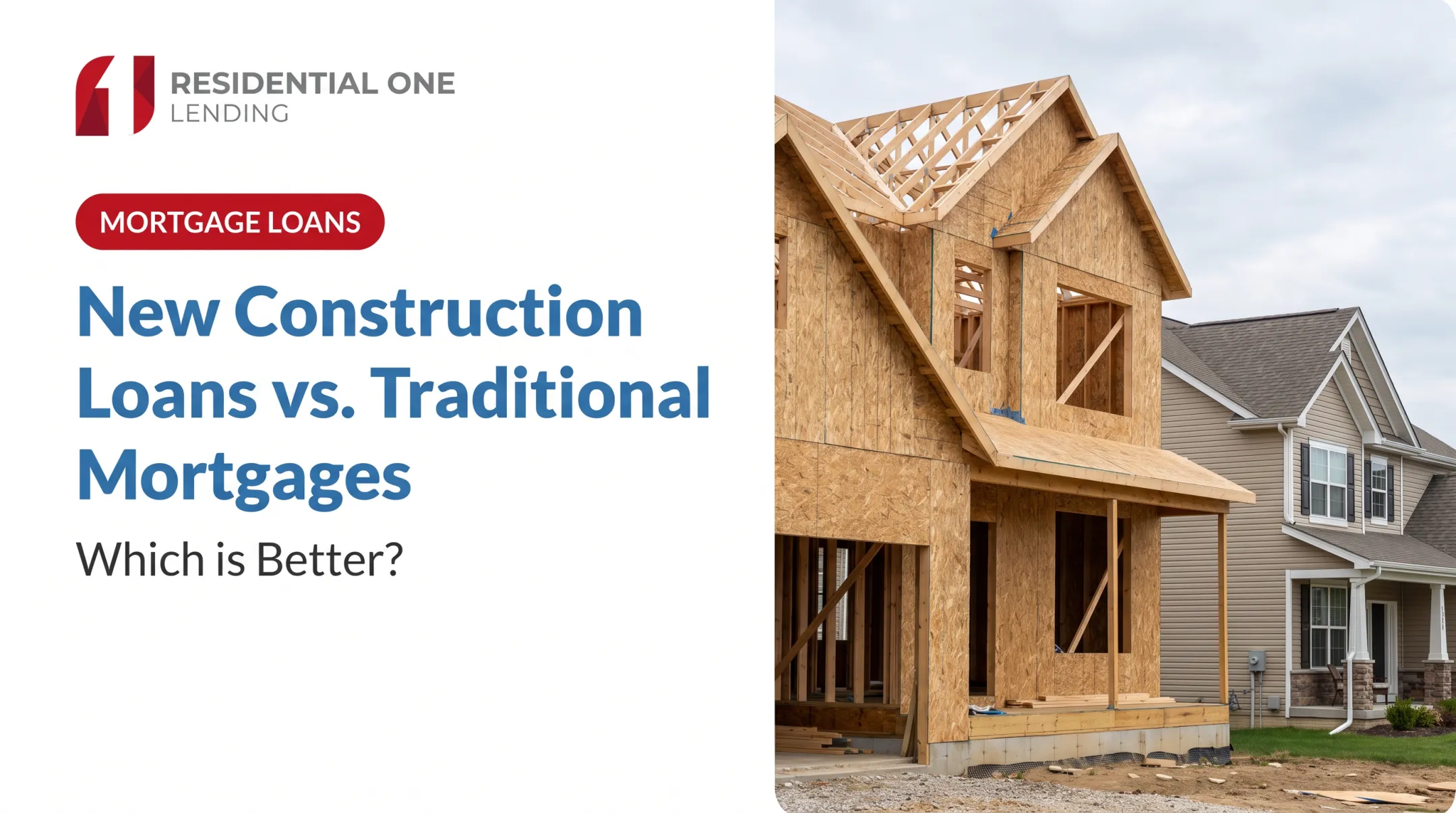
Many borrowers assume the two products work the same way with different paperwork. They don't. Construction loans typically involve staged draws, interest only payments during the build, and detailed scrutiny of your builder and budget. Traditional mortgages fund in one lump sum at closing and settle into predictable principal and interest payments right away.
This guide breaks down the practical differences, so you can figure out which financing structure actually fits your situation, whether that's a completed home purchase or a ground-up build.
Key Takeaways
- Construction loans fund active building or major renovation; traditional mortgages fund completed properties.
- Milestone draws and interest only payments fund the build; traditional mortgages disburse in full at closing.
- Plans, budgets, timelines, and builder docs stack on top of standard financial paperwork.
- Construction-to-permanent loans combine the build phase and long term mortgage into one structure.
- Match your choice to project stage, cash on hand, timeline, and how much construction risk you’ll manage.
Construction Loan vs. Traditional Mortgage: Quick Comparison
Here's how the two products compare side by side.
| Criteria | Construction Loan | Traditional Mortgage |
|---|---|---|
| Purpose | Funds eligible building or major renovation costs against an approved budget | Finances purchase or refinance of a completed property |
| Fund distribution | Staged draws tied to inspections and milestones | Full disbursement at closing |
| Term & repayment | Short term (often ~1 year); often interest only on drawn funds | 10–30 year amortization with principal and interest payments |
| Pricing | Often variable, tied to project risk and draw activity | Fixed or adjustable rates; easier apples to apples shopping |
| Underwriting | Reviews borrower, builder, plans, budget, permits, and appraisal | Reviews borrower credit, income, assets, and property appraisal |
| Collateral | Based on projected completed value; delay and cost overrun risk | Completed property secures the loan immediately |
Why the Distribution Method Matters
A construction loan doesn't hand you a check. Funds move as work gets done: site prep, foundation, framing, mechanical systems, and finishes, with the lender typically inspecting each stage before releasing the next draw.
A traditional mortgage works differently. At closing, the seller gets paid (or your refinance completes), and you begin fixedschedule payments the next month—no inspection cycle, builder invoices, or draw approvals.
Why Pricing Comparisons Get Tricky
Construction loan pricing tends to run higher or more variable because the lender is financing something that doesn't exist yet and absorbing completion risk.
For reference, Freddie Mac's November 2024 Outlook Chart Book reported a 6.72% average 30 year fixed rate for traditional mortgages as of late October 2024. Use that figure as a benchmark against construction quotes—not as a locked rate.
Rates move constantly, so always request current quotes rather than relying on historical figures:
- Construction pricing reflects project and completion risk
- Traditional mortgage rates are easier to shop and compare
- Side-by-side quotes beat any published average
What Is a Construction Loan?
A construction loan is short term financing—often about a year—that pays for building a home that doesn't exist yet, or for a major renovation of one that does. When the house is finished, the loan usually converts into a traditional mortgage (the "end loan").
How the Draw Process Works
Funds release in stages rather than as one lump sum. A typical (though lender specific) sequence might look like:
- Closing — about 10% at loan closing
- Site work and foundation — after the lot is cleared and the foundation is poured
- Framing — once the structural frame is up
- Systems and rough-ins — after HVAC, plumbing, and electrical pass inspection
- Finishes and completion — final draw after punch list items and final inspection
Banks typically inspect each stage before releasing the next draw. The exact schedule is negotiated among builder, borrower, and lender.
Your first funds usually come from your own down payment, so your money is often first at risk if problems surface early.
Interest Only Payments During the Build
During construction, you usually pay interest only on funds already drawn—not the full approved amount. On a $400,000 loan with $175,000 disbursed, interest applies to that $175,000 only. Payments rise as later draws go out.

Three Common Structures
- Construction only — paid off with cash or a separate mortgage when the home is finished
- Construction-to-permanent — rolls into a long term mortgage after completion and avoids a second closing; Fannie Mae generally caps the single close construction phase at 18 months before requiring two separate closings
- Renovation/rehab — funds major work on an existing home (for example FHA 203(k) or Fannie Mae HomeStyle Renovation)
What Lenders Look For
Beyond standard credit, income, and debt-to-income review, construction lending typically adds:
- A licensed builder with a proven track record
- Detailed plans, an itemized budget, and a realistic timeline
- A larger down payment than a typical purchase mortgage
- Permits, an appraisal on projected completed value, and cash reserves
Exact thresholds differ by lender and program—confirm current criteria for your project before you lock a plan.
Use Cases of Construction Loans
Construction financing tends to fit specific scenarios:
- Building a custom primary residence on land you own or are buying
- Combining land purchase and construction costs when the lender allows it
- Funding a renovation too extensive for a standard purchase mortgage
Custom building is still a large share of new housing. NAHB's 2025 analysis of Census data counted 176,932 custom homes started in 2024—17.5% of all new single family starts.
A family that already owns a lot and has plans with a licensed builder still can't use a traditional mortgage: there is no finished home to appraise or secure. They need construction financing that releases funds as the builder hits milestones.
Residential One Lending offers construction and renovation mortgage options, including construction-to-permanent loans. Eligibility and structure depend on the project, so review the details with a licensed loan professional.
What Is a Traditional Mortgage?
A traditional mortgage is long term financing secured by a completed property. It's the standard route for purchasing or refinancing a primary residence, second home, or eligible investment property.
The Standard Process
Traditional mortgages follow a familiar path:
- Prequalification or preapproval based on your financial profile
- Property selection and purchase agreement
- Full application and document submission
- Underwriting, appraisal, and title review
- Closing with lump sum funding
- Regular principal and interest repayment beginning the following month
Qualification Factors
Lenders evaluate:
- Credit history and score against program guidelines
- Verified income and assets that support the monthly payment
- Debt-to-income ratio within the lender’s limits
- Down payment as low as 3% conventional or 3.5% FHA for qualified borrowers
- Property appraisal, clear title, and homeowners insurance
Conventional loans typically come in 10, 15, 20, or 30 year terms with fixed or adjustable rate options, and are underwritten to Fannie Mae or Freddie Mac guidelines.

When a Traditional Mortgage Fits
A traditional mortgage generally fits when:
- Purchasing a move in ready single family home
- Buying a completed condo, townhome, or duplex
- Refinancing an existing mortgage
- Purchasing an eligible second home or investment property
One caveat: a standard mortgage typically won't fund significant repairs. FHA 203(k) and Fannie Mae HomeStyle Renovation loans bridge that gap by rolling purchase and renovation costs into one mortgage.
Match conventional, FHA, VA, USDA, or jumbo options to the property type and your credit profile before you apply.
Construction Loan vs. Traditional Mortgage: Which Is Better?
Neither loan is universally better. The right call starts with one question: does the property already exist in the condition you need, or does construction still need to happen?
Choose a Construction Loan If You:
- Have a documented project with finalized plans and a licensed builder
- Can work within a lender's draw and inspection schedule
- Have reserves to absorb potential timeline or budget changes
- Are building new or completing a qualifying major renovation
Choose a Traditional Mortgage If You:
- Are purchasing or refinancing a completed property
- Want a familiar, predictable long term repayment structure
- Prefer standard underwriting without construction stage oversight
- Need immediate ownership rather than a multi month build timeline
Compare Total Costs, Not Just Rates
Look beyond the advertised interest rate:
- Origination charges and draw/inspection fees
- Builder related costs and possible extension charges
- Closing costs on the construction loan
- The cost of a separate permanent mortgage, if not using construction-to-permanent financing
Evaluate Your Readiness
Ask yourself honestly:
- Is your credit and income stable enough for the underwriting scrutiny construction financing demands?
- Do you have cash reserves to cover payments during the build and absorb unapproved overruns?
- Are your plans, budget, permits, and builder locked in, or still in flux?
Real World Decision Cues
Loan structure changes the math. In a Fannie Mae HomeStyle Renovation case study, first time buyer Alan needed work done on his target home.
Compared with an FHA 203(k), HomeStyle required 3% down instead of 3.5%, put purchase and renovation in one loan, and landed at a 48% debt-to-income ratio versus 51% under the alternative.

Use these cues as a starting point:
- Ready to build → construction financing
- Ready to buy a completed home → traditional mortgage
- Buying a fixer upper → renovation-specific structure
Every project is different. Outcomes depend on your credit profile, property, and lender. Residential One Lending can walk through construction, construction-to-permanent, renovation, conventional, and government backed options based on your project and finances. No approval or rate is guaranteed until you're underwritten.
Conclusion
Construction loans finance the creation or major improvement of a property. Traditional mortgages finance completed homes over a longer repayment period. That's the core distinction. The practical differences run deeper:
- Draw schedules versus lump sum funding
- Interest only construction payments versus standard amortization
- Builder and budget scrutiny versus standard purchase underwriting
Those structural gaps are why rate shopping alone is a weak way to choose. Compare total financing structure, draw procedures, conversion terms, and contingency planning before you commit.
Residential One Lending is a mortgage brokerage that provides personalized guidance on construction, renovation, purchase, refinance, conventional, and government backed options, subject to licensing and program availability in your state. Call 866-320-3265 to talk through your specific project.
Frequently Asked Questions
What is the minimum FICO score required for a construction loan?
There's no single universal minimum. Requirements vary by lender, loan type, project risk, down payment, and income profile. Verify current guidelines with your loan officer before assuming a specific threshold.
Which loan is best for construction?
The right choice depends on your build timeline and permanent financing needs. Construction only, construction-to-permanent, and renovation loans like FHA 203(k) or HomeStyle each fit different scenarios. Compare options with a licensed mortgage professional.
Do I need a down payment for a construction loan?
Most construction loans require cash or land equity, with amounts varying by lender, program, and project value. Some renovation programs allow down payments as low as 3.5%, depending on credit and eligibility.